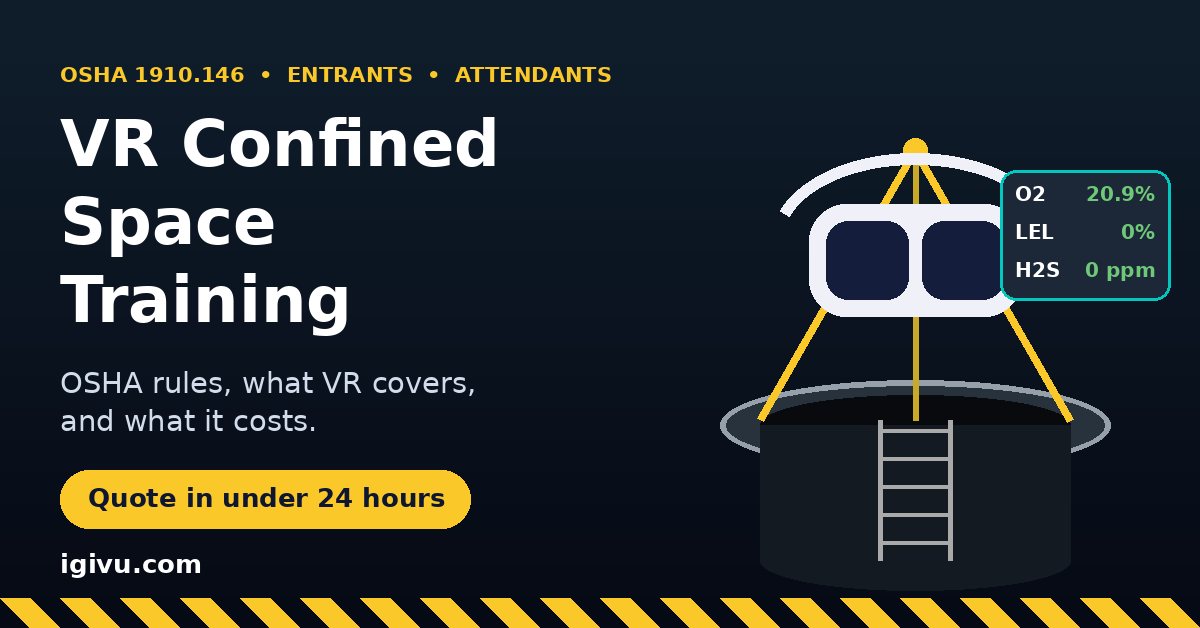
Confined spaces kill in a way that surprises people: quietly, fast, and often more than one person at a time. If your crews enter tanks, vaults, manholes, silos or crawl spaces, you have probably wondered whether VR confined space training is worth it, and whether it counts toward OSHA’s training rules. This guide answers both honestly and shows what it costs to run.
Quick answer: VR confined space training lets entrants, attendants and entry supervisors practice permit checks, air testing order, hazard recognition and emergency decisions inside a realistic virtual space, with zero exposure to bad air. It supports OSHA’s training rules but doesn’t replace hands-on practice with your own gas meter, retrieval gear and rescue plan. Rentals start at $900 per headset per day.
What is VR confined space training?
VR confined space training is a headset-based simulation where workers walk through a permit-required confined space entry and make the same decisions they would make on the job. They stand at the opening, run the checks, and see what happens when someone skips a step.
Depending on the module, a session can have workers:
- Identify which spaces are confined spaces and which need a permit
- Read an entry permit and check that it’s complete before anyone goes in
- Test the atmosphere in the right order: oxygen, then flammable gases, then toxic gases
- Play the attendant’s role: keep count of entrants, watch for warning signs and order an evacuation
- Face an emergency and choose the right response, which is usually to call rescue, not to climb in
IGIVU’s Safety Day catalog includes Awareness Training on Confined Spaces, part of a library of industrial safety content developed with Immersive Factory. Confined space can be one station in a wider Safety Day.
Why does confined space training matter so much?
Because confined space accidents are often fatal, and the deaths frequently include would-be rescuers. NIOSH has long warned that more than 60% of confined space fatalities occur among people attempting a rescue (NIOSH).
Recent OSHA cases show the same patterns. In Mobile, Alabama, two workers died after being overcome by sewer gas in a manhole; OSHA found the employer lacked confined space entry procedures, training and emergency response plans (U.S. Department of Labor, Feb. 2026). In Corpus Christi, Texas, a worker asphyxiated while inspecting a tanker trailer, and OSHA cited the company for failing to implement a confined space program, with $264,380 in proposed penalties (OSHA, July 2026).
The common thread is recognition and planning, exactly the decisions VR lets you rehearse safely.
What does OSHA require for confined space training?
OSHA requires training before a worker is first assigned confined space duties, whenever duties or hazards change, and whenever the employer sees gaps or deviations from procedures. The training must establish proficiency, and you need records.
| Requirement | General industry (29 CFR 1910.146) | Construction (29 CFR 1926.1207) |
|---|---|---|
| Who must be trained | All employees whose work is regulated by the standard: entrants, attendants, entry supervisors, rescuers | Each employee whose work is regulated by the standard, at no cost to the employee |
| When | Before first assignment, before a change in duties, when operations present a new hazard, when deviations or knowledge gaps appear | Same triggers |
| What it must achieve | Understanding, knowledge and skills for safe performance; proficiency in assigned duties | Same, plus understanding of the dangers of attempting a rescue for those not authorized to do one |
| Language | Not specified in 1910.146(g) | In a language and vocabulary the employee understands |
| Records | Certification with each employee’s name, trainer signatures or initials, and dates | Records with employee name, trainer names and dates, kept for the length of employment |
| Rescue practice | In-house rescuers practice at least once every 12 months in actual or representative permit spaces | Covered in the rescue section of Subpart AA |
Sources: 29 CFR 1910.146 and 29 CFR 1926.1207.
Is online or VR confined space training acceptable to OSHA?
It can be part of your training, but not all of it. OSHA has said self-paced computer-based training alone doesn’t satisfy its training requirements unless it includes hands-on components and timely access to a qualified trainer (OSHA letter, 2019).
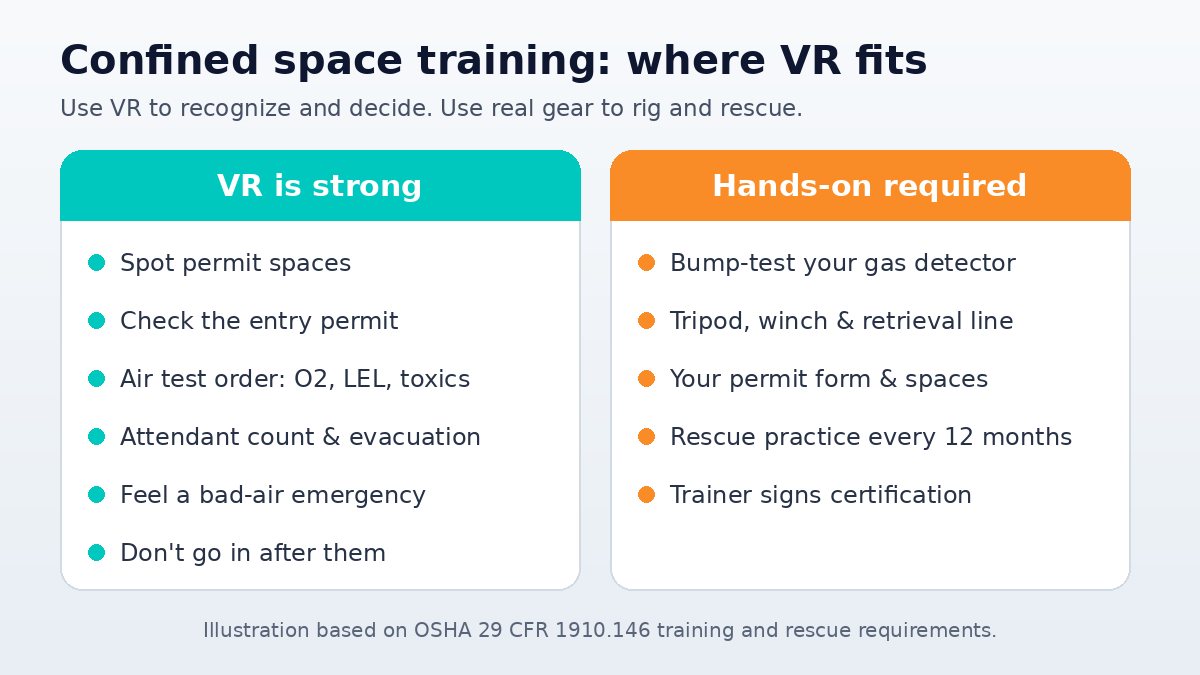
A facilitator in the room covers the “ask a trainer” point. But confined space work has physical skills that need real equipment: calibrating and bump-testing your gas detector, rigging a tripod and retrieval line, and the annual rescue practice OSHA spells out. The honest approach is to use VR for recognition and decisions, then finish with hands-on practice on your own gear.
What can VR teach well, and what still needs hands-on practice?
VR is strongest at the “recognize and decide” parts of confined space training and weakest at the “touch and rig” parts.
| Training element | VR or AR | Hands-on with real gear |
|---|---|---|
| Recognizing confined and permit-required spaces | Strong | Site walk of your own space inventory |
| Reading and checking an entry permit | Strong | Use your actual permit form |
| Air testing order and acceptable readings | Strong for the decision | Required with your detector |
| Attendant duties and evacuation calls | Strong | Good as a tabletop or drill |
| Experiencing a toxic or oxygen-poor atmosphere safely | Strong (impossible to do for real) | Never |
| “Don’t go in after them” emergency choice | Strong | Reinforce in drills |
| Tripod, winch and retrieval line setup | Awareness only | Required |
| Rescue team practice | Awareness only | Required at least once every 12 months |
How do you run a VR confined space training session?
Most teams make it one station in a Safety Day or a refresher block, with workers rotating through headsets in small groups. A format that works:
- Map your spaces. List the spaces your crews enter and who plays which role.
- Brief for 5 minutes. Cover your permit system, your detector and your rescue plan.
- Rotate through VR. Each worker runs the scenario while others watch on a cast screen and call out what they’d do.
- Move to the gear station. Your trainer runs detector checks and retrieval setup with real equipment.
- Debrief and document. Talk through missed steps, then complete your training certification records.
IGIVU says a VR Safety Day usually runs 4 to 6 hours, setup takes about 30 to 45 minutes, and no prior VR experience is needed. Sessions can run across shifts and at multiple sites in all 50 states (Safety Day).
How often is confined space training required?
OSHA doesn’t set an expiration date or a mandatory annual class for entrants and attendants. You must retrain before a change in duties, when operations bring a new hazard, and when workers deviate from procedures or show gaps. In-house rescue teams are the exception: they must practice a simulated rescue at least once every 12 months (1910.146(g) and (k)). Many employers still schedule a yearly refresher.
How much does VR confined space training cost?
Renting is the low-cost way in. IGIVU’s VR Safety Day starts at $900 per headset for a day, and the full Safety Day Experience with an on-site consultant starts at $1,990.
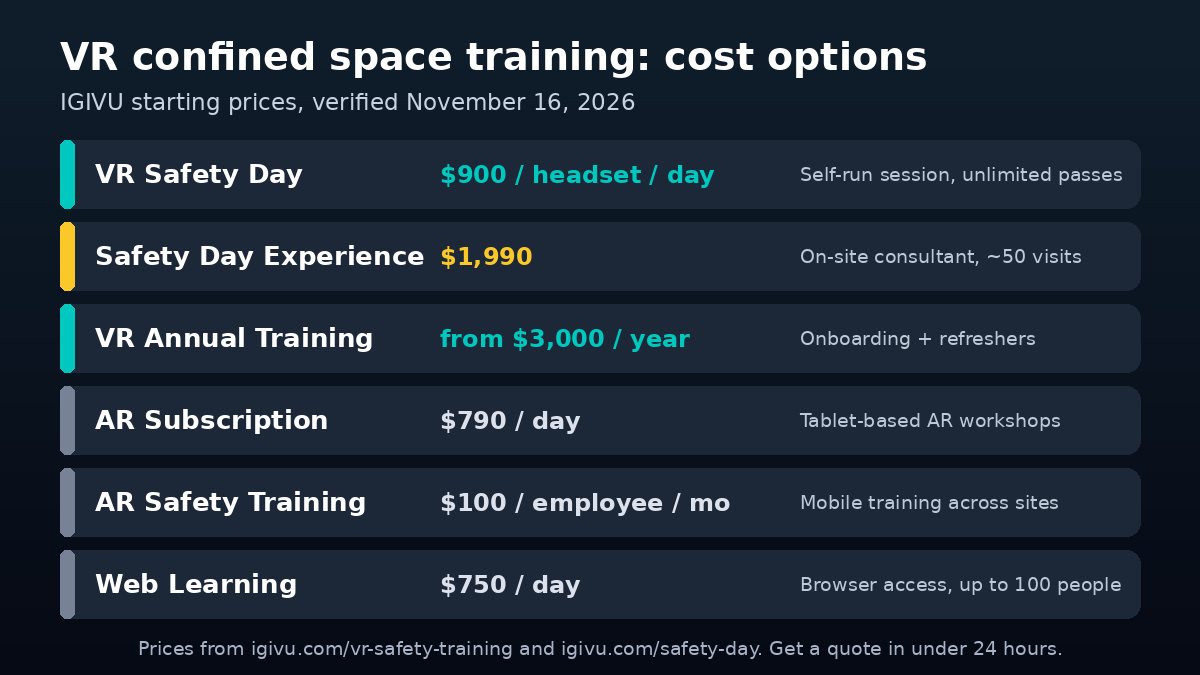
| Option | Starting price | Best for |
|---|---|---|
| VR Safety Day (SafetyBox VR) | $900 per headset, one day | A self-run session at your site, unlimited passes that day |
| Safety Day Experience | $1,990 | A full day with an on-site technician or consultant, about 50 visits per consultant |
| VR Annual Training | From $3,000 per year | Onboarding and refreshers all year, 30+ VR experiences |
| AR Subscription | $790 per day | Tablet-based AR workshops, no headset |
| AR Safety Training | $100 per employee per month | Ongoing mobile training across sites |
| Web Learning | $750 per day | Browser access for up to 100 people |
Prices from IGIVU’s VR safety training and Safety Day pages, verified November 16, 2026. For more on what drives price, see our guide to VR safety training cost.
Should you rent or buy a confined space simulator?
Rent if you train a few times a year; buy if you train every week. Most confined space simulators are sold as per-headset licenses or subscriptions. If you train a few times a year, renting gets you headsets, loaded content and support only for the days you need them. If your spaces are unusual, custom VR content can recreate them; IGIVU says custom safety content typically takes 4 to 8 weeks.
Who should use VR confined space training?
Any team whose people enter, attend or supervise work in spaces not built for people to occupy:
- Water, wastewater and utility crews working in manholes, vaults and lift stations
- Manufacturing and food plants with tanks, hoppers, silos and pits
- Construction crews in crawl spaces, attics, tanks and underground structures
- Facilities teams and host employers who bring in contractors for permit entries
For related programs, see our VR safety training use cases, our VR fall protection training guide and our guide to OSHA VR training.
Frequently asked questions
Can confined space training be done online or in VR only?
Not completely. OSHA says computer-based training alone doesn’t meet its requirements unless it includes hands-on practice and timely access to a qualified trainer. Use VR or online modules for hazard recognition and decisions, then practice with your own gas detector, retrieval equipment and rescue plan.
Is confined space training required annually?
Not for entrants and attendants. OSHA requires training before first assignment and retraining when duties change, new hazards appear or workers show gaps. Employees designated for in-house rescue must practice a simulated permit space rescue at least once every 12 months.
What are the confined space training requirements under OSHA?
Under 29 CFR 1910.146(g), training must establish proficiency in each worker’s duties and be certified with the employee’s name, trainer signatures or initials, and dates. Construction (1926.1207) also requires a language the worker understands.
Who needs confined space entry training?
Everyone with a role in a permit entry: authorized entrants, attendants, entry supervisors, people who test the atmosphere, and rescuers. Workers who won’t enter should still learn to recognize permit spaces and the dangers of attempting a rescue.
How much does VR confined space training cost?
Renting a VR Safety Day from IGIVU starts at $900 per headset for a day. A full Safety Day Experience with an on-site consultant starts at $1,990, and VR Annual Training starts at $3,000 per year.
How many workers can be trained in one day?
IGIVU says a standard VR Safety Day handles 15 to 200 employees depending on the package, and the Safety Day Experience covers about 50 visits per consultant.
Get a VR confined space training quote
IGIVU has served 3,000+ organizations with VR and AR rentals, safety training content and on-site support nationwide. Tell us your sites, headcount, shifts and the spaces your crews enter, and we’ll recommend scenarios and a package. Request a quote and you’ll hear back in under 24 hours, or email [email protected].