
Most teams handle fire extinguisher training the same way every year: a slideshow, a quick video, and maybe a session behind the building with a burn pan and a borrowed extinguisher. It ticks the box, but few people ever actually pull a pin before the day they need to.
VR fire extinguisher training changes that. Here’s a plain-spoken guide to how it works, what OSHA actually requires, what it costs to buy versus rent, and how to roll it out before winter.
Quick answer: VR fire extinguisher training uses a headset to put employees in front of realistic virtual fires, where they choose the right extinguisher, practice the PASS technique, and decide when to evacuate. There’s no live fire, smoke, or cleanup. Buying a simulator starts at a few thousand dollars, and renting for a training day costs far less.
What is VR fire extinguisher training?
It’s hands-on extinguisher practice inside a virtual environment. Trainees wear a VR headset, face a small fire in a realistic setting like an office break room, warehouse, or kitchen, and have to put it out (or get out) using the right technique.
A good module covers more than spraying. At IGIVU, our VR fire safety training includes:
- Fire detection and response: spotting the fire type early and choosing the right response under time pressure.
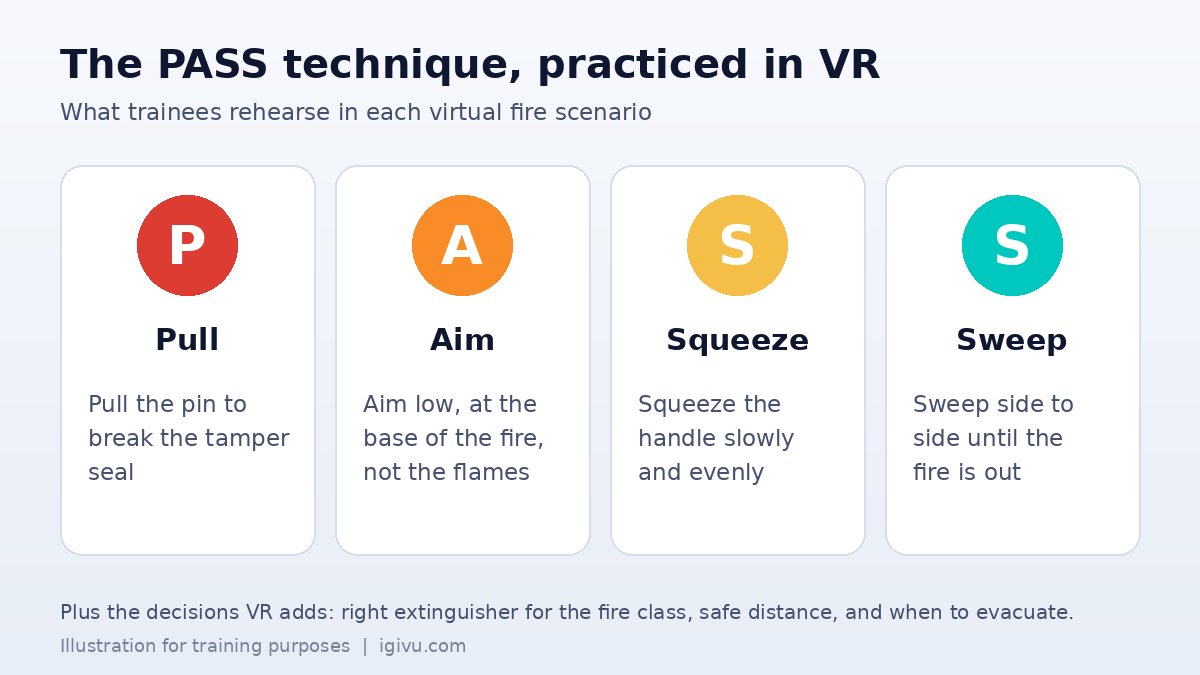
- Virtual extinguisher practice: the PASS technique (Pull, Aim, Squeeze, Sweep) with no real-world risk.
- Electrical and kitchen fire scenarios: the high-risk fires common in offices, factories, and commercial kitchens.
- Smoke-filled environments: moving and making decisions with limited visibility.
- Evacuation and assembly: calm, orderly exits, assembly points, and headcounts.
How does VR fire extinguisher training work?
An instructor or facilitator picks a scenario, the trainee puts on a standalone headset, and the simulation responds to what they do. Wrong extinguisher, standing too close, or aiming at the flames instead of the base, and the fire keeps growing.
A typical session looks like this:
- Briefing (2–3 minutes). Fire classes, extinguisher types, and your site’s rule on when to fight a fire and when to evacuate.
- Practice room. The trainee gets comfortable with the headset and controls.
- Scenario run. Raise the alarm, pick the right extinguisher, approach at a safe distance, and use PASS.
- Debrief. Many systems show mistakes on screen at the end, and some cast the headset view to a TV so the whole group can watch and learn.
Most headsets used for this are standalone, like the Meta Quest 3, so there are no PCs or cables. Some systems add a physical prop extinguisher with a pullable pin for extra realism.
Does VR fire extinguisher training meet OSHA requirements?
It can cover a big part of it: OSHA requires an educational program on extinguisher use when employees are first hired and at least annually after that, and VR is a strong way to deliver it. OSHA judges VR training case by case, so pair it with your site-specific plan.
Here’s what the standard, 29 CFR 1910.157(g), says:
| Who | What OSHA requires | How often |
|---|---|---|
| All employees, where extinguishers are provided for employee use | Education on the general principles of extinguisher use and the hazards of fighting incipient (early-stage) fires | On hire and at least annually |
| Employees designated to use firefighting equipment in your emergency action plan | Training in the use of the appropriate equipment | On assignment and at least annually |
| Workplaces with a total-evacuation policy and no extinguishers for employee use | May be exempt from 1910.157, with an emergency action plan and fire prevention plan in place | N/A |
In a 2020 letter of interpretation, OSHA said whether online or VR training is “adequate” or “effective” can only be decided case by case, and that effective training should include hands-on practice and a chance to ask questions (OSHA). In practice, that means:
- Use VR for the annual education and for repeat practice of PASS and fire-class decisions.
- Have a facilitator in the room to answer questions and tie the training to your own emergency action plan.
- For designated fire wardens or response teams, consider adding a prop-extinguisher system or a periodic live demonstration.
- Keep records of who trained and when.
We cover the wider compliance picture in our OSHA VR training guide.
Is VR better than live-fire extinguisher training?
For most workplaces, VR is easier to run and easier to repeat, while live fire gives the real feel of a discharging extinguisher. Many safety teams use VR every year and save live demos for designated responders.
| Live-fire training | VR fire extinguisher training | |
|---|---|---|
| Setup | Outdoor space, fuel, extinguishers to recharge, cleanup, often a permit or fire department help | A headset and a few square feet indoors |
| Practice runs | Limited by extinguishers and fuel | Unlimited; reset and run again |
| Fire types | Usually one (a burn pan) | Several, like electrical, kitchen, and paper or trash fires |
| Weather | Hard to run in winter | Runs indoors year-round |
| Realism | Real heat, weight, and kickback | Realistic visuals and sound; prop extinguishers add weight and a pin |
| Feedback | Instructor’s eye | On-screen results and group casting |
How much does VR fire extinguisher training cost?
Buying a dedicated simulator usually costs about $4,800 to $11,000 up front, plus renewals. Renting for a training day starts under $1,000, with no hardware to store or update.
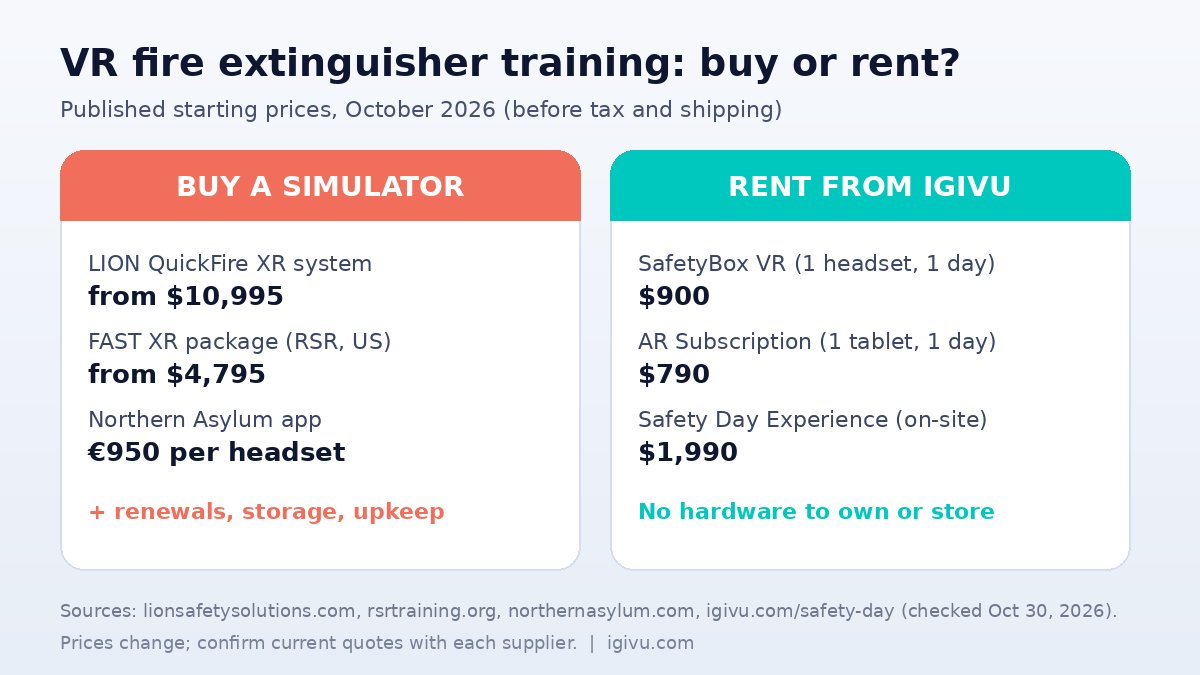
Published starting prices we found this month:
- LION QuickFire XR: trainer system from $10,995, with a headset, prop extinguisher, and instructor tablet (LION Safety Solutions).
- FAST XR through Ready Set Rescue Training: packages from $4,795 with a Meta Quest 3, two training extinguishers, and 30 days of software. Continued use needs more licensing (RSR Training).
- Northern Asylum Fire Extinguisher Training app: €950 per headset for a lifetime license, with the headset sold separately (Northern Asylum).
Buying makes sense if you train every week across one site. If you train once or twice a year, or across several locations, renting is usually cheaper. IGIVU’s published Safety Day packages include:
| IGIVU option | Listed price | Best for |
|---|---|---|
| SafetyBox VR | $900 | One VR headset delivered to your office for a day, access to the full catalog, unlimited employee passes that day |
| AR Subscription | $790 | Tablet-based AR safety workshops (the AR collections include a fire safety simulator), unlimited passes for one tablet for a day |
| Safety Day Experience | $1,990 | A full-day event with an on-site technician or consultant, full VR equipment, and about 50 visits per consultant |
| Custom fire training | Custom quote | Training built around your own facility, routes, and equipment |
Ask us which fire modules fit your site when you request a quote.
How do you roll out VR fire extinguisher training?
Start small: pick a group, pick the scenarios that match your real fire risks, and run a pilot day. Then expand to annual refreshers and new-hire onboarding.
- Match scenarios to your hazards. Kitchens need grease fires, warehouses need stock and battery-charging areas, offices need electrical and trash fires.
- Decide who gets which level. Everyone gets awareness. Designated responders get deeper practice.
- Plan throughput. A run takes a few minutes, so add headsets or stations for large groups.
- Keep it clean. Use face covers and sanitize between users (see our headset hygiene guide).
- Record completion. Log names and dates for your annual training records.
Off-the-shelf modules can deploy within days, since headsets arrive configured with content. Custom training built around your facility typically takes 8 to 12 weeks, depending on complexity.
Why run fire extinguisher training before winter?
Fire risk climbs in the cold months, and VR runs indoors no matter the weather. NFPA reports that 46 percent of home heating fires happen from December through February, and December is a leading month for U.S. home fires (NFPA).
Space heaters under desks, holiday decorations, and busy break-room kitchens bring the same risks to work. A November or December refresher also fits neatly into year-end Safety Days. Our workplace emergency training can bundle fire response with evacuation and medical scenarios.
Frequently asked questions
Does OSHA require hands-on fire extinguisher training?
OSHA requires education on extinguisher use for all employees when extinguishers are provided for their use, and training “in the use of the appropriate equipment” for designated responders, both at least annually. It doesn’t require discharging an extinguisher at a live fire. OSHA does say effective training should include hands-on practice.
Can VR replace annual fire extinguisher training?
For many employees, VR can deliver the annual education OSHA requires, especially with a facilitator present and your emergency action plan covered. For designated fire responders, use VR alongside training on your actual equipment.
How long does a VR fire extinguisher session take?
A single scenario run usually takes a few minutes. With a short briefing and debrief, plan about 10 to 15 minutes per person, and add headsets to keep larger groups moving.
How much does a VR fire extinguisher simulator cost?
Published starting prices range from about $4,795 (FAST XR through RSR) to $10,995 (LION QuickFire XR system), plus renewals. Renting from IGIVU starts at $900 for a SafetyBox VR day.
What is the PASS technique?
PASS stands for Pull the pin, Aim low at the base of the fire, Squeeze the handle, and Sweep side to side. VR lets employees practice it as many times as they need.
Ready to plan your fire safety training?
IGIVU has served 3,000+ organizations nationwide from our Dallas headquarters, with VR and AR safety training, event rentals, and on-site support. Tell us how many people you need to train, where, and which fire risks matter most, and we’ll send a clear quote in under 24 hours.
Get your free fire safety training quote or email [email protected].