
Lockout/tagout is the procedure that keeps a machine from starting up while someone has their hands inside it. It is also one of the safety rules employers miss most often. In OSHA’s preliminary fiscal year 2026 Top 10, lockout/tagout (29 CFR 1910.147) ranked third, with 1,863 violations (National Safety Council). OSHA estimates that following the standard prevents about 120 deaths and 50,000 injuries each year (OSHA fact sheet). This guide covers what lockout tagout training must include, who needs which level, how often to retrain, where VR fits and what it costs.
Quick answer: Lockout tagout training teaches workers to isolate and verify every energy source before servicing a machine. OSHA 1910.147 sets three levels (authorized, affected and other employees), requires retraining when jobs, equipment or procedures change, and requires written certification. VR adds safe, repeatable practice of the full sequence. Hands-on practice on your own equipment is still required.
What is lockout tagout training?
Lockout tagout training is the instruction OSHA requires so employees understand your energy control program and can safely apply, use and remove locks and tags. It covers electrical, mechanical, hydraulic, pneumatic, chemical, thermal and stored energy.
The standard applies to servicing and maintenance in general industry. Examples include clearing a jammed conveyor, changing a blade or cleaning a mixer. Construction, agriculture and some electrical work fall under other OSHA rules (see OSHA’s hazardous energy page). Training is one part of a full program. The others are written, machine-specific procedures and an annual inspection of those procedures.
What does OSHA require for lockout tagout training?
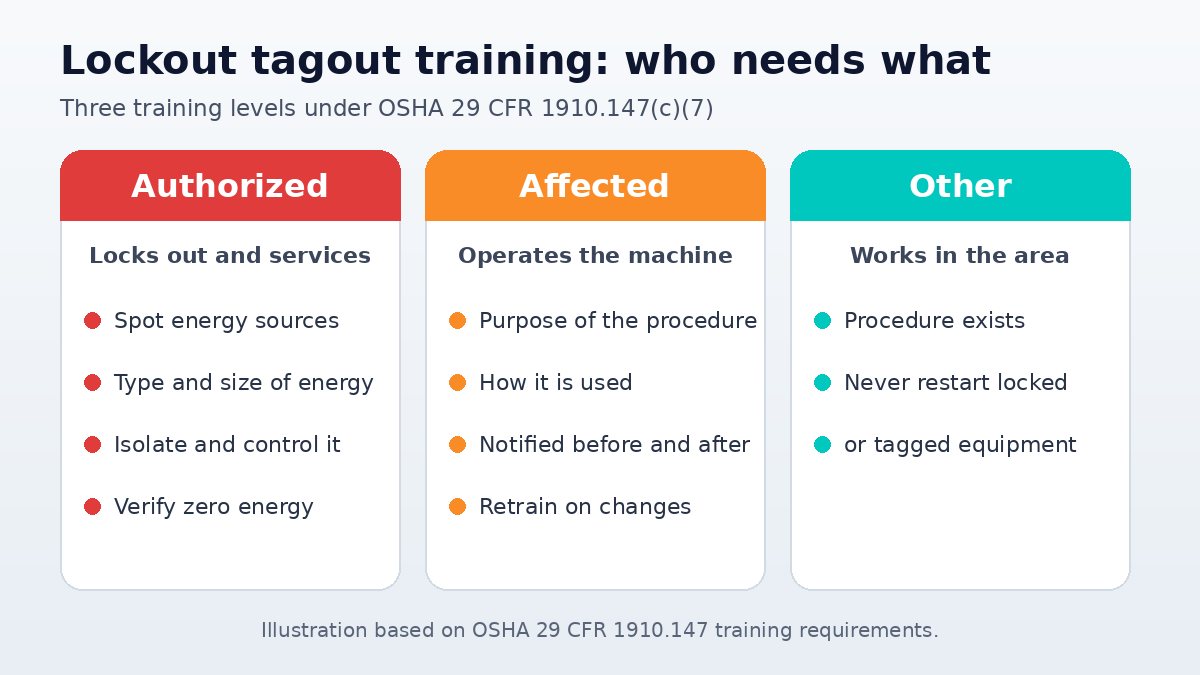
OSHA requires different training for three groups of workers, set out in 29 CFR 1910.147(c)(7). The training must make sure workers understand the program and gain the skills to apply, use and remove energy controls.
| Role | Who it is | What they must learn |
|---|---|---|
| Authorized employee | The person who locks out and services the machine | How to recognize hazardous energy sources, the type and size of energy in your workplace, and how to isolate and control it |
| Affected employee | Operators and others who use the machine being serviced | The purpose and use of the energy control procedure |
| Other employees | Anyone who works in an area where lockout may happen | That the procedure exists, and that they must never try to restart locked or tagged equipment |
Sites that use tags without locks must also teach the limits of tags. Under 1910.147(c)(7)(ii), employees must learn that:
- A tag is only a warning. It does not physically stop anyone the way a lock does.
- A tag may only be removed by the authorized person responsible for it, and it must never be bypassed or ignored.
- Tags must be legible, durable and securely attached.
- Tags can create a false sense of security.
How often is lockout tagout training required?
OSHA does not set a fixed renewal date for lockout tagout training. Retraining is triggered by events, and the annual inspection of each procedure is the regular check on whether people still know it.
Under 1910.147(c)(7)(iii), authorized and affected employees must be retrained when:
- Their job assignment changes
- A new machine, equipment or process brings a new hazard
- The energy control procedure changes
- A periodic inspection, or anything else, shows gaps in their knowledge or use of the procedure
Two related requirements follow. First, under (c)(6) each energy control procedure must be inspected at least once a year by an authorized employee who isn’t using it, and that inspection includes a review with the employees. Second, under (c)(7)(iv) you must certify that training is done and up to date, with each employee’s name and training dates. Many safety teams pair the annual inspection with a refresher, which makes January a natural time to plan.
Does lockout tagout training expire?
No, there is no set expiration date in 1910.147. Training stays valid until one of the retraining triggers above happens. Many employers still refresh it every year so it lines up with the annual inspection and keeps records simple.
Can lockout tagout training be done online or in VR?
Online or VR training can be part of lockout tagout training, but it can’t be all of it. In a 2019 interpretation letter, OSHA said online training alone is not enough. Training needs interactive and hands-on parts, and workers need timely access to a qualified trainer.
VR goes much further than a slideshow because trainees actually do each step. They find the energy sources, choose the isolation points, place the locks and test for zero energy. To meet the full requirement, add a qualified trainer in the room and a hands-on walkthrough on your own machines using your written procedures.
What does a VR lockout tagout simulation cover?
A good VR lockout tagout module follows the same six-step order that 1910.147(d) requires, and it lets trainees make mistakes safely. IGIVU’s VR training for manufacturing includes LOTO scenarios where workers practice identifying energy sources, applying lockout devices and verifying zero-energy states.
| Step (1910.147(d)) | What the trainee does in VR | Mistake VR can safely show |
|---|---|---|
| 1. Prepare | Identifies every energy source and its hazards | Missing a second source, such as compressed air |
| 2. Shut down | Stops the machine with its normal procedure and notifies affected workers | Skipping the notification |
| 3. Isolate | Operates each disconnect, valve and breaker | Isolating the wrong panel |
| 4. Lock and tag | Applies a personal lock and tag at each point | Using a tag where a lock is required |
| 5. Release stored energy | Bleeds pressure, blocks parts that could fall, lets hot parts cool | A part that drops or pressure that releases suddenly |
| 6. Verify | Tries to start the machine and tests for zero energy before working | Starting work without verifying |
Where does VR fit in a lockout tagout program?
Use VR for recognizing hazards and building the habit of following the steps in order. Use real equipment and your own procedures for qualification.
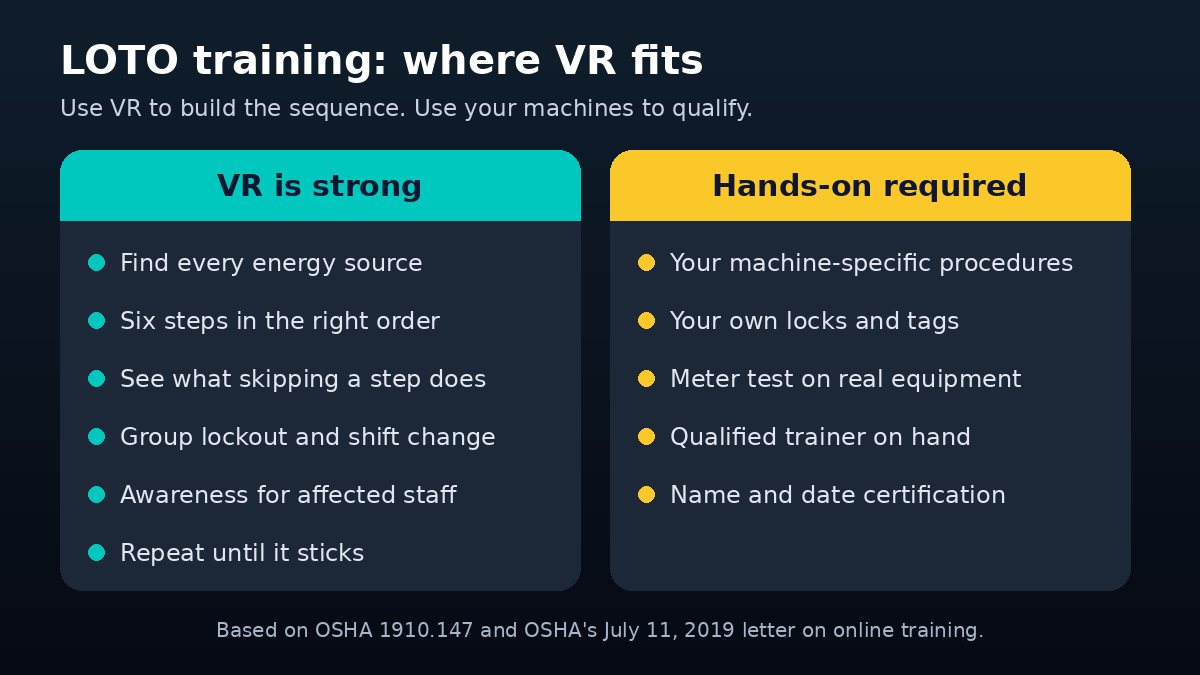
- VR is strong for: energy source recognition, step order, seeing what happens when a step is skipped, group lockout and shift change walkthroughs, and awareness sessions for affected and other employees.
- Hands-on is required for: your machine-specific procedures, your actual lock and tag hardware, using a meter on real equipment, and a qualified trainer’s sign-off and certification.
Need training built around your own machines? IGIVU can build custom VR training from 3D models made with your CAD data, photos and on-site measurements. Related reading: VR confined space training, VR fall protection training and VR forklift training.
How much does VR lockout tagout training cost?
With IGIVU, VR safety training starts at $900 per headset for a VR Safety Day. Full-day facilitated programs start at $1,990, and year-round programs start at $3,000 per year. These are IGIVU’s published starting prices, checked November 20, 2026.
| Option | Starting price | Best for |
|---|---|---|
| Safety Day pilot | $500 | Small teams of up to 15 people trying VR first |
| VR Safety Day | $900 per headset | Self-run sessions at your site |
| Safety Day Experience | $1,990 | A full day with an on-site consultant, about 50 visits per consultant |
| VR Annual Training | From $3,000 per year | Onboarding and refreshers across 30+ VR safety experiences |
| AR Safety Training | $100 per employee per month | Mobile and tablet training without headsets |
| Custom LOTO module on your equipment | Quoted per project | Machine-specific practice that matches your procedures |
See the details on the VR safety training and Safety Day pages, or compare budgets in our VR safety training cost guide.
How do you plan a lockout tagout training day with VR?
Plan VR lockout tagout training like any other qualification session. Start with your procedures, then match each group of workers to the right level of training.
- List your machines and procedures. Mark any equipment that is new or has changed this year, since both trigger retraining.
- Sort people by role. Authorized employees get the full VR sequence plus hands-on practice. Affected and other employees get a shorter awareness session.
- Schedule around the annual inspection. Run the refresher right after each procedure is inspected.
- Book headsets and a facilitator. Rotate small groups through VR stations and the hands-on station.
- Certify. Record each name and training date to meet 1910.147(c)(7)(iv).
Not sure where to start? Request a free safety assessment or book a VR training demo.
Frequently asked questions
What are the three levels of lockout tagout training?
OSHA 1910.147 sets three levels. Authorized employees learn to recognize, isolate and control hazardous energy. Affected employees learn the purpose and use of the procedure. All other employees in the area learn that the procedure exists and that they must never restart locked or tagged equipment.
How often is lockout tagout training required by OSHA?
OSHA sets no fixed interval. Retraining is required when job assignments, machines, processes or procedures change, or when an inspection shows gaps. Each procedure must also be inspected at least once a year, so many employers refresh training every year.
Does lockout tagout training expire?
There is no set expiration date in 29 CFR 1910.147. Training stays valid until a retraining trigger occurs, such as a new job, new equipment, a changed procedure or an inspection that finds gaps. Many employers still refresh it every year.
Is online or VR lockout tagout training OSHA compliant?
Online or VR training alone is not enough. OSHA’s 2019 interpretation letter says training needs interactive and hands-on parts and access to a qualified trainer. VR covers the interactive practice. Add a hands-on walkthrough on your own equipment with a qualified trainer.
What is the difference between an authorized and an affected employee?
An authorized employee locks or tags out a machine to service it. An affected employee operates or uses that machine, or works in the area where servicing happens. Authorized employees need the deepest training. Affected employees must understand the procedure and be told before locks are applied and after they are removed.
How much does VR lockout tagout training cost?
With IGIVU, a VR Safety Day starts at $900 per headset, a full-day Safety Day Experience with an on-site consultant starts at $1,990, and VR Annual Training starts at $3,000 per year. Custom modules built around your own machines are quoted per project.
Get a VR lockout tagout training quote in under 24 hours
IGIVU is a nationwide XR company based in Dallas that has served 3,000+ organizations. We bring VR safety training to your site with ready-to-use content, headsets and on-site support, or we build custom modules around your equipment. Tell us your headcount, locations and target dates, and we will send a quote in under 24 hours. Contact IGIVU or email [email protected].